
Discover Cheap Flights to Domestic and International Destinations in Brazil

Top Cities to Travel in 2026
Book your dream flight easily with our leading flight comparison service




















Welcome to TICKETS!
Find the ideal platform to compare flights on TICKETS. Compare prices, schedules, and options from multiple airlines in one place to plan your perfect trip.
About TICKETSFind Cheap Flights Departing from Your Location
The most affordable flights from your region are automatically identified based on the most searched countries

Sao Paulo Guarulhos
Nov 2026
Nonstop
One Way
Cascavel
Nov 2026
From
R$203
Sao Paulo Viracopos
Nov 2026
Nonstop
One Way
Bauru-Arealva
Nov 2026
From
R$208Sao Paulo Congonhas
Nov 2026
Nonstop
One Way
Londrina
Nov 2026
From
R$214
Sao Paulo Guarulhos
Nov 2026
Nonstop
One Way
Uberlandia
Nov 2026
From
R$217Sao Paulo Guarulhos
Nov 2026
Nonstop
One Way
Curitiba
Nov 2026
From
R$229Sao Paulo Guarulhos
Nov 2026
Nonstop
One Way
Belo Horizonte Tancredo Neves Int'l.
Nov 2026
From
R$237Sao Paulo Congonhas
Nov 2026
Nonstop
One Way
Sao Jose Do Rio Preto
Nov 2026
From
R$239Sao Paulo Guarulhos
Nov 2026
Nonstop
One Way
Zona da Mata
Nov 2026
From
R$240Sao Paulo Guarulhos
Nov 2026
Nonstop
One Way
Joinville
Nov 2026
From
R$242Sao Paulo Viracopos
Nov 2026
Nonstop
One Way
Rio de Janeiro Internacional
Nov 2026
From
R$244Explore the Best Destinations: Amazing Flights by Continent
Travel information by continents and countries with the cheapest flight prices


Cheap Flights to Cities We Love
Our unbeatable flight deals make your dream trips more affordable than ever


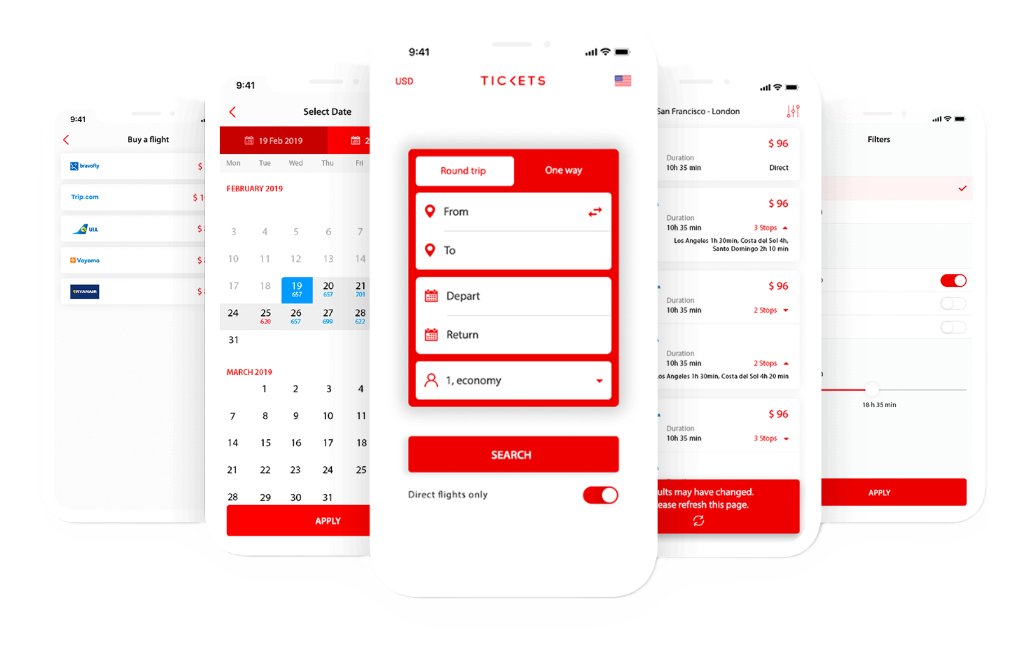
Compare flight prices on the go. The TICKETS iOS app searches 1,200+ airlines and booking sites in real time, so you find the cheapest fare anywhere — free, no signup, save trips and set price alerts.
Cheap flights from Brazil: when to buy, how far in advance, and how to actually save
How far in advance should I book a flight to get the cheapest fare?
To lock in a cheap flight on short and medium domestic routes like São Paulo–Rio or São Paulo to the Northeast, the sweet spot is usually one to two months before departure, centered around the six-week mark. Booking too early tends to cost more on these routes, so the old "buy as soon as you can" advice is mostly a myth here. A long international flight, like São Paulo to Lisbon, Buenos Aires or Orlando, needs more runway, several months ahead, and busy routes in high season need even more. A single fare changes dozens of times before the trip, so hunting for the one perfect day is a losing battle: set a price alert and let the TICKETS app ping you with a notification when the fare moves. The rule that never fails: don't leave it to the final two weeks, which is when prices climb the fastest.
So when is the genuinely cheapest time to buy a flight?
Here's the twist a lot of Brazilian travelers get wrong: a fare to São Paulo or Rio bottoms out partway through the selling period, and grabbing it the moment seats open is one of the priciest things you can do. Fares start high in the very-early window, drift down to a floor around six weeks before departure, and then rise as the plane fills up. Both extremes, buying too early and buying last-minute, hit your wallet: the good deal lives in the middle. The exception is long-haul flights and Brazil's high season — July holidays, New Year's, Carnival — when seats genuinely sell out, so booking several months ahead protects both the price and availability. For a short off-peak trip, there's no rush; for a long or busy one, lock it in early. Instead of guessing where your route falls, let the buy-now-or-wait feature on TICKETS.COM.BR weigh about 12 months of price history and tell you whether to buy now or hold off.
Which day of the week is cheapest to fly — and is it even worth it?
To fly cheaper, depart midweek and avoid Sunday. Tuesday and Wednesday usually carry the lowest fares, while Sunday tends to be the priciest day to fly out, when everyone is heading home. The best day shifts by route and season, so treat "midweek, not Sunday" as the rule rather than chasing one magic day. The saving is small on short, cheap hops like a shuttle route, and more meaningful on long international flights, where moving off the weekend shaves a real amount per person. One important distinction: this is the day you fly, not the day you buy — the old "book on Tuesday" tip is dead, since fares now refresh constantly, not once a week. To spot the cheapest stretches across the calendar, the month price view in the date picker points to the low months; the midweek rule handles the day.
Why do two separate one-way tickets sometimes beat any airline's round trip?
Two one-way tickets on different airlines sometimes come out cheaper than a round trip because they can land below any round-trip fare a single airline publishes. On every round-trip search, TICKETS.COM.BR also prices the outbound and return separately and pairs the cheapest outbound leg with the cheapest return leg into one combined result. This two-ticket combo only appears when it actually beats the best normal round trip, with the saving shown on screen; if a regular round trip ties or wins, that's what you see. The catch is that the combo is two separate tickets and two confirmations, so you need to open both booking pages before paying for either one. TICKETS.COM.BR flags the combo so you know exactly what you're booking, and the math only works when the difference is real.
Should I buy two one-way tickets instead of a round trip?
Buying two one-way tickets instead of a round trip is sometimes worth it, and you don't even have to look for it by hand, because every round-trip search on TICKETS.COM.BR already tests this option. When the cheapest outbound and the cheapest return sit on different airlines, two one-way tickets can add up to less than any round-trip fare. TICKETS.COM.BR pairs them into a single combined result, but only shows it when it beats the best normal round trip, with the saving highlighted. The thing to watch is logistical: the combo is two separate tickets, on two airlines. You confirm each leg on your own and re-check your bags at the connection, instead of having a bag tagged straight through to your destination. For a simple there-and-back with carry-on only, this usually isn't a problem; with tight connections or checked luggage, weigh the saving against the extra hassle.
If my dates can flex, how much is that flexibility really worth?
Ask any seasoned traveller in Brazil what saves the most on a cheap flight and the answer is room to move your dates, because flexibility lets you stack savings instead of relying on one trick. Swap the weekend for midweek, then shift to a low-season month, and the two add up to a real cut off a peak weekend fare. Low season alone is the strongest lever here: the quieter stretches between holidays usually sit well below the July school break or the year-end rush of New Year's with Carnival right behind it, so a GRU–GIG shuttle or a Recife run lands cheaper outside those windows. Which months come out cheapest varies by route, region and hemisphere, but "avoid the obvious peaks" holds almost everywhere. Picking the perfect day of the week, by contrast, saves little on a cheap route. That's why a whole-month view beats checking one date at a time: on TICKETS.COM.BR, the date picker shows an indicative cheapest fare per month across several months, so the low months jump out at you in reais.
Is it worth flying from a different airport to save on the fare?
Yes, swapping your departure airport can shave a good chunk off the fare in Brazil, because low-cost carriers tend to base themselves where airport fees are lower, and those savings land directly on the price you pay in reais. The catch is the door-to-door cost. A cheaper fare from a distant airport only pays off after you add parking, transport to get there and the extra travel time. In São Paulo, for example, Guarulhos (GRU) handles international flights and some domestic ones, while Congonhas (CGH) sits right next to the city and focuses on domestic — the choice shifts both the fare and the travel time; in Rio it's the same between Galeão (GIG) and Santos Dumont (SDU). TICKETS.COM.BR detects the airport nearest you, and you can set your origin airport manually. There's no automatic radius search that bundles neighboring airports into one query, so to test a secondary one, you set it as the origin and compare. The destination map is the fastest way to sweep prices from your region to lots of places. Bottom line: compare the total trip cost, not just the headline fare.
Is a cheaper self-transfer worth the risk of missing the flight?
On a self-transfer out of São Paulo, the reais you save are really the premium you skip — there is no insurer here but you. A self-transfer stitches two separate tickets, often on airlines with no agreement between them, into one journey, and the airlines have no obligation to protect that join. The real risk is the connection. If the first leg is delayed and you miss the second, that airline owes you nothing; you count as a no-show passenger and may have to buy a fresh ticket. You also collect and re-check your own bags between legs, and any refund is assessed per ticket. So price in the worst case, not the headline fare: leave a generous connection, a few hours with carry-on only and even more with checked bags or an airport change, and consider missed-connection cover. TICKETS.COM.BR surfaces these self-transfer options with the warning, and the route map flags every airport change so you can decide with everything in the open.
Are flight price alerts worth it, or are they just noise?
A price alert won't predict your São Paulo–Lisbon fare; what it does is react the instant the fare drops. Since a fare changes many times before the trip, a price alert through the TICKETS app tracks a route and sends you a push notification the moment it actually falls — which turns timing into a rule instead of a guess. Set it, then buy in the cheap window or on a genuine dip. Alerts pay off most when your dates are flexible, when you're booking well ahead, or when you're tracking long international routes, which swing harder. The blind spot: a flash fare from one of those overnight promos can vanish before any alert fires. If you want the trend rather than a single ping, the buy-now-or-wait feature weighs about a year of price history and rates it as buy, wait or neutral. In the TICKETS app, price alerts are free.
Will this fare drop, or should I just buy the flight now?
The honest answer to "will it drop?" lives in one number: how today's fare on a route like São Paulo–Rio stacks up against its own 12 months of history — and that's the exact read the buy-now-or-wait feature on TICKETS.COM.BR delivers. Enter a route and it returns one of three answers — buy now, wait or neutral — each with a confidence level, the cheapest and most expensive months, and whether the trend is rising, falling or steady. The rule that goes with the data: inside the cheap window (around six weeks out on short routes, a few months on long ones) and at or below the route's usual level, buy. Early in the cycle and with prices high for the season, waiting can pay off. The strongest signal is the simplest: don't leave it to the final two weeks, when prices climb the fastest. Still unsure? Set a price alert and let the swings decide for you.
If it's free with no markup, how does TICKETS.COM.BR actually make money?
Picture a booking out of Guarulhos: you find the fare, you book, and only then — once the trip is paid for — does the seller hand TICKETS.COM.BR a referral commission, with nothing coming out of your pocket. The fare you see is the airline's or online travel agency's own price, passed straight through with no markup. When you click to book, we send you to the provider's own site to pay in reais, and they pay us a referral commission. That commission doesn't change the price you see or pay, so comparing flights, the month price view, the destination map and the buy-now-or-wait feature are all free — as are route price alerts in the TICKETS app. We only earn on a completed booking, with no subscription, no booking fee and no markup baked into the fare.
What time of year is the cheapest to buy a flight in Brazil?
The cheapest time of year to buy a flight in Brazil is low season, in the calmer stretches between holidays; that single choice is worth more than any day-of-the-week trick. Fares usually ease off around March and April (after Carnival and summer) and again in August and September (once the July holidays are over). The expensive windows are the July holidays, the year-end with New Year's and the Carnival season, plus the December-to-February summer at the Northeast's beach destinations. This flips with route, region and hemisphere — a Northern Hemisphere summer or a local festival can turn it all around — but "avoid the obvious holiday and summer peaks" holds almost anywhere. On TICKETS.COM.BR, you can see destination price information showing the cheapest and most expensive months across 12 months, so the better-value routes are easy to spot; then just search flights on the results page to see the fares available right now.